
 By Aliza Beth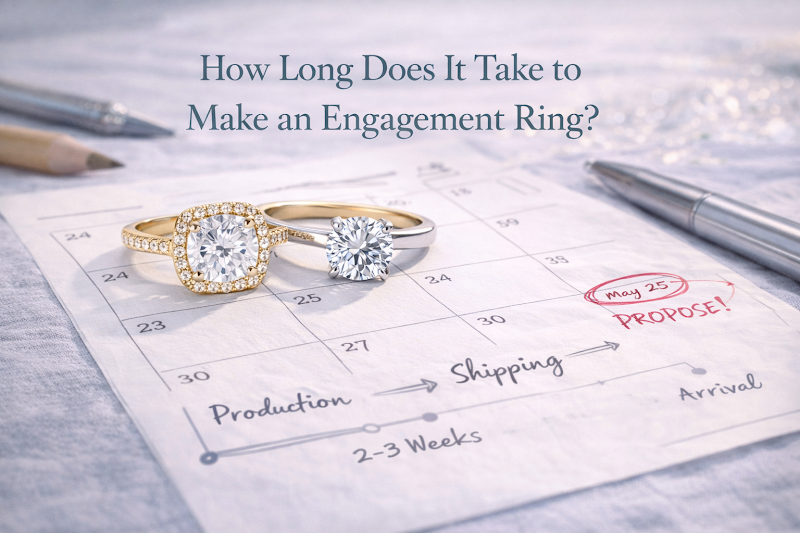
If you’re planning a proposal, timing suddenly becomes very real.
You may already have a meaningful date in mind — an anniversary, a birthday, or a special trip. Somewhere between comparing stone options and narrowing down engagement ring styles, one practical question starts to matter more than anything else:
How long does it actually take to make an engagement ring?
In most cases, a made-to-order engagement ring takes about two to three weeks for production, with shipping time added afterward. Custom designs often require three to six weeks or more, depending on complexity. The total timeline depends on how the ring is produced and how the jeweler manages the process.
Understanding what happens behind the scenes makes planning far more manageable.
Ready-to-Ship vs. Made-to-Order Rings
One of the biggest misconceptions is assuming engagement rings are sitting in inventory, ready to ship immediately.
While some pieces are pre-made, most engagement rings are made to order. That means production begins only after you select:
- Metal type
- Center stone
- Ring size
Even a simple solitaire goes through casting, stone setting, polishing, and inspection before it ever leaves the workshop.
When estimating engagement ring production time, the first step is confirming whether the ring is ready-made or crafted specifically for you.
What Happens During the Jewelry Manufacturing Process?
An engagement ring moves through several skilled stages before it reaches its box.
Casting the Setting
The chosen metal — gold or platinum — is shaped into the ring’s structure.
Stone Setting
A jeweler carefully secures the center stone and any accent stones, ensuring alignment and stability.
Polishing and Finishing
The ring is refined to achieve a smooth surface and clean shine.
Quality Inspection
Before shipment, craftsmanship and stone security are thoroughly checked.
Each step requires coordination and precision. Even with efficient workflow, this jewelry manufacturing process cannot be rushed without affecting quality.
Across much of the industry, this full sequence typically requires two to three weeks.
Why Custom Engagement Rings Take Longer
If you choose a fully custom design, additional stages are involved before production even begins.
The custom engagement ring process often includes:
- CAD (computer-aided design) renderings
- Client review and revisions
- Stone sourcing
- Final approval before casting
Each revision may require adjustments to the digital model. Only once the design is approved does physical production begin.
Because of this collaboration, custom engagement rings frequently require three to six weeks, sometimes longer depending on complexity.
The advantage is personalization. The trade-off is time.
Production Time vs. Shipping Time
Another common misunderstanding is assuming production and shipping are the same thing.
Production time refers to how long it takes to make the ring.
Shipping time refers to how long it takes to deliver it once completed.
For example:
- 2–3 weeks production
- 3–7 business days shipping
That can bring total delivery close to a month.
When asking how long it takes to make an engagement ring, always clarify whether shipping is included in the estimate.
Separating these stages is especially important if you’re planning around a proposal date.
How In-House Manufacturing Can Influence Timeline
Timeline differences often come down to how production is managed.
Some jewelers coordinate multiple third-party workshops for casting, setting, and finishing. Others operate their own manufacturing facilities, keeping the entire process under one roof.
When design, casting, stone setting, and inspection happen internally, workflow can move more efficiently.
For example, Romalar Jewelry operates its own factory and outlines standard production windows of six to eight business days before shipping begins, with rush options available for tighter timelines. While timelines vary across the industry, understanding whether a jeweler manages its own manufacturing can help buyers estimate delivery more accurately.
In-house production doesn’t remove craftsmanship — it streamlines communication and coordination.
For buyers working with a fixed proposal date, that distinction can matter.
Planning Around a Proposal Date
If your proposal date is already set, the safest strategy is to work backward.
Start with the day you plan to propose. Then subtract:
- Shipping time
- Production time
- A buffer of several extra days
Weather delays, holiday demand, and carrier backlogs can all affect delivery. Allowing extra time reduces unnecessary stress.
If your schedule is tight, ask whether expedited production or rush shipping is available.
Clear answers make confident planning possible.
Questions to Ask Before You Order
Before placing your order, consider asking:
- Is this ring made to order?
- What is the exact production window?
- When does shipping begin?
- Are rush options available?
- What happens if resizing is needed?
These are simple questions — but they protect an emotional milestone from logistical surprises.
A Practical Perspective
It’s easy to focus on carat size, metal tone, or setting style. But timeline is just as important.
Most engagement rings are crafted pieces that require time and skilled labor. That time is part of their value.
For standard made-to-order rings, expect approximately two to three weeks of production, plus shipping. Custom pieces require longer. Some factory-owned operations may complete production more quickly depending on workflow structure.
The key is transparency.
When engagement ring production time is clearly stated and delivery expectations are realistic, planning becomes straightforward.
And when the ring arrives with time to spare, you can focus on what truly matters — the moment you ask the question.
 Andrew